

Key Takeaways
Moving to Thailand with family requires coordinating visas, school enrollment, healthcare coverage, and housing before arrival, and each family member typically needs their own visa application filed separately. Thailand offers families affordable living costs, internationally accredited hospitals, strong international schools, and multiple long-term visa categories including the DTV, LTR (which now covers an expanded number of dependents), and Non-O dependent visas linked to employment or to minors enrolled in school. For a smooth transition, many expat families turn to professional relocation services in Thailand that coordinate immigration, documentation, and settling-in support under one roof.

Thailand continues to attract expat families thanks to its affordable cost of living, modern healthcare facilities, well-regarded international schools, and a lifestyle that puts family first. For those asking how to move to Thailand with your family, understanding the legal and administrative requirements, including managing visa applications for every family member, should be the first item on your list.
Successfully relocating entails more than just visas; it requires picking an appropriate neighborhood, arranging for international school enrollment, securing quality healthcare, and adapting to the everyday routines of establishing life in a foreign country. This guide covers family options, pre-arrival preparations, and available support resources.
Is Thailand A Good Place To Raise A Family?
For most expat families, the answer is yes. Thailand’s cost of living runs roughly 40 to 50 percent lower than the US and around 35 percent lower than the UK across housing, food, and transport, though prices vary by city. Bangkok, Chiang Mai, Phuket, and Hua Hin all have established expat communities with the infrastructure families need.
Education: Thailand is home to over 200 international schools offering British, American, IB, and other curricula. Bangkok has the largest concentration of international schools, but Chiang Mai, Phuket, and Hua Hin have similarly reputable options. Enrollment timelines vary, so starting the application process months before your move is important.
Healthcare: Major cities offer internationally accredited private hospitals with English-speaking doctors. Bumrungrad, Samitivej, and Bangkok Hospital are among the most recognized, and many expat families find the quality of care comparable to or better than what they had at home. Well priced inpatient or comprehensive insurance policies are available for purchase.
Lifestyle: A warm climate year-round, a strong food culture, and a welcoming local attitude toward families make daily life comfortable from the start. Weekend trips to beaches, mountains, and cultural sites are all within easy reach, and the overall pace of life tends to be more relaxed than most Western cities.
Choose The Right Visa For Your Family
What visa do I need to move my family to Thailand? The answer depends on your employment status, income, and how long you plan to stay. Here are the most common pathways for families:
Non-O Dependent Visa (Linked to Employment or School)
If one parent holds a Thai work permit through a local employer, their spouse and children can apply for Non-O dependent visas. This is the most traditional route for families relocating for work. A parent of a child enrolled in school can also qualify for a Non-O dependent visa.
LTR Visa (10-year)
Thailand’s Long-Term Resident (LTR) visa is administered by the Board of Investment (BOI), the government agency responsible for attracting foreign investment and talent to Thailand. The LTR allows the primary applicant to include dependents (spouse and children) under separate, linked applications. The Thai Cabinet approved expanded dependent rights in early 2025, removing the previous cap on the number of dependents. Eligible applicants must meet the income or investment thresholds for one of four categories: Wealthy Pensioner, Wealthy Global Citizen, Highly-Skilled Professional, or Work-from-Thailand Professional.
Key benefits for LTR holders include:
- Address reporting just once a year instead of the standard every-90-days requirement that applies to most other visa types
- A digital work permit (no need to carry a separate physical document)
- A flat 17% personal income tax rate on Thai-sourced employment income
- Tax exemptions for foreign sourced income remitted to Thailand.
DTV Visa for Families
The Destination Thailand Visa (DTV) is a 5-year, multiple-entry visa that permits stays of up to 180 days per entry. While each family member files an individual application, dependents apply under the primary holder’s status. The primary applicant must demonstrate the required financial backing (at least 500,000 THB held in a bank account for three months), alongside proof of family relationship (such as certified marriage or birth certificates) and valid health insurance for all family members. Requirements vary somewhat by Thai embassy or consulate, so confirm the specific documentation list with the issuing post before applying.
Retirement and marriage visas
The Non-O retirement visa (age 50+) and Non-O marriage visa (married to a Thai national) are individual visas that do not extend to dependents. A spouse or child would need their own separate Non-O dependent visa, filed independently with supporting documentation proving the family relationship. For families where one parent holds a retirement or marriage visa, dependent applications for the rest of the family can run in parallel.
Preparing The Required Documents
What documents do I need to relocate my family to Thailand? Every family member applying for a visa needs their own set of paperwork, even when the family applies together. The specifics vary by visa category, but most applications require the following:
Passports and travel documents: Valid for at least 12 months beyond your intended entry date. Children need their own passports.
Marriage and birth certificates: Required to prove family relationships for dependent visas. These must be officially translated into English (and sometimes Thai) and certified by your home country’s authorities for use abroad.
Financial and employment documents: Depending on the visa type, you may need bank statements showing the required minimum balance, employment contracts, income verification letters, or tax returns. For the DTV, the primary applicant needs to show roughly 500,000 THB held for at least three months.
Document legalization: Foreign-language documents typically require certified translation and legalization through your home country’s embassy or consulate before submission to Thai authorities.
Planning Your Family’s Move
Once visas are underway, you can start planning for the following:
Finding housing: Most expat families rent before buying. Standard lease terms are 12 months. Neighborhoods like Sukhumvit, Sathorn, and Thong Lo in Bangkok are popular with families for their proximity to international schools and hospitals. Outside Bangkok, Chiang Mai’s Nimman area, Phuket’s Laguna zone, and Hua Hin’s central district all have strong expat rental markets. An experienced broker such as Property Scout can assist with your search. [Link here]
Choosing the right school: International school waitlists can be long, especially at top-tier schools in Bangkok. Start the enrollment process as early as possible, ideally six months to a year before your move. Most schools require transcripts, recommendation letters, and a student interview or assessment.
Arranging healthcare and insurance: Private health insurance is essential, and many visa categories require proof of coverage as part of the application. Compare international insurance plans against local Thai options. Some families use a combination of both. Experienced broker can help you understand your options. [link here]
Settle Into Life In Thailand
After arriving, carry out these final few steps to help your family get settled in quickly:
Open a bank account: Requirements vary by bank, but most will need your passport, visa, work permit (if applicable), and proof of Thai address. Some banks require a letter from your employer or a minimum deposit. Having a Thai bank account simplifies rent payments, school fees, and daily expenses.
Register your address: Thai immigration law requires foreigners to report their address within 24 hours of arrival. Your hotel or landlord typically handles this initial registration (Form TM30) . After that, 90-day reporting is required for most visa types (though the LTR visa reduces this to once per year).
Build a support network: Expat communities are active in every major Thai city. Facebook groups, school parent communities, and local expat clubs are the fastest way to find practical advice, recommendations, and social connections for the whole family.
Common Challenges Families Face When Relocating
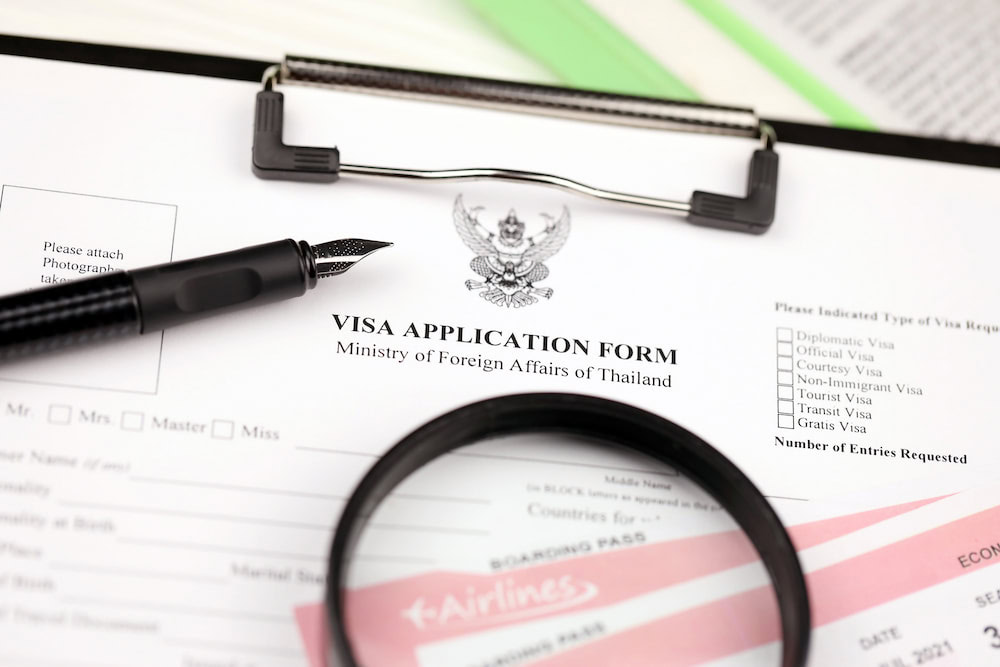
Even well-planned moves can hit bumps. The most frequent issues expat families encounter include:
Choosing the wrong visa category: Applying for a visa that does not cover dependents, or one that does not match your employment or income situation, wastes time and money. Getting professional advice before filing is far cheaper than correcting a mistake after the fact.
Document preparation delays: Legalization, translation, and apostille requirements differ by country and by visa type. Starting document preparation too late is the single most common cause of missed enrollment deadlines and delayed arrivals.
School application timelines: Top international schools fill up quickly. Families who wait until after arrival to start looking often find themselves on waitlists for a full academic year.
Understanding local immigration requirements: Rules around 90-day reporting, re-entry permits, visa extensions, and address registration can be confusing for first-time expats. Small administrative oversights can lead to fines or complications at renewal time.
How Baan Thai Supports Family Relocations
Instead of coordinating immigration, documentation, housing, and school research independently, many families choose professional relocation services in Thailand to handle the moving parts together.
Baan Thai Immigration Solutions has been helping expat families move to Thailand since 2021. The firm’s bilingual team of experienced counselors and attorneys handles visas, permanent residency, work permits, and company registration under one roof. For families, that means coordinating the primary applicant’s visa alongside each dependent’s application so nothing falls through the cracks. Baan Thai also connects clients to preferred partners for housing, health insurance, tax planning, estate planning, and financial advisory services.
Co-founded by Mark Friedman, a California Bar member with over 20 years of general counsel experience, and author of the book Make Thailand Home [link], the firm combines American service capability with Thai legal expertise.
Explore how to move to Thailand with Baan Thai Immigration Solutions. Our bilingual counselors can walk your family through visa eligibility, document requirements, and relocation planning before you make your move. Get your free, no-obligation consultation today. A counselor will reach out to you within 48 hours.
References
- Thailand Long-Term Resident (LTR) Visa. Retrieved July 17, 2026, from https://ltr.boi.go.th/
- Thailand Approves Update of Long-Term Resident (LTR) Visa’s Criteria and Conditions. Retrieved July 17, 2026, from https://www.boi.go.th/index.php?page=press_releases_detail&topic_id=136393&_module=news&from_page=press_releases2&language=en
- Destination Thailand Visa (DTV) Required Documents. Retrieved July 17, 2026, from https://image.mfa.go.th/mfa/0/SkhASF0m67/Thai_Visas/DTV.pdf
- Thailand Immigration Bureau. Retrieved July 17, 2026, from https://www.immigration.go.th/